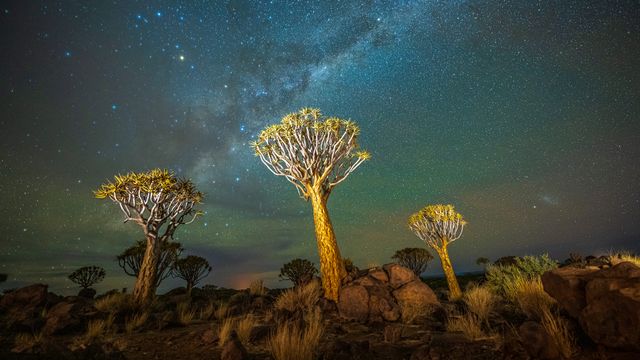
Quiver trees at night with the Milky Way, Keetmanshoop, Namibia
© Wim van den Heever/naturepl.co
Quivering under starlight. Quiver trees, Keetmanshoop, Namibia
Of all the plants on Earth, the quiver tree looks the most like a vision from the future. Found in Southern Africa, including parts of Namibia, these striking giants are not true trees but a species of aloe adapted to life under the desert's scorching sun. Their thick trunks store water, while their branches reflect heat, helping them endure harsh conditions. Reaching up to 7 metres in height, with some living for more than 100 years, quiver trees are also vital to their ecosystem. They offer rare perches and nesting sites for birds in landscapes where few other trees exist.
The name 'quiver' comes from the Indigenous San people, who once hollowed out the branches to craft lightweight arrow holders or quivers. The Quiver Tree Forest near Keetmanshoop is a national monument and one of Namibia's most photographed sites. With some of the clearest skies on Earth, the desert provides a perfect backdrop for stargazing. In today's image, quiver trees stand silhouetted against the Milky Way. Though climate shifts are altering their natural range, these trees remain a symbol of Namibia's rugged beauty—and a reminder of how nature adapts in the most imaginative ways.
Related Images
 Climbing Athabasca Glacier in Jasper National Park, Alberta, Canada as the Aurora Borealis glows
 Bubble Nebula (NGC 7635)
 Earthrise across Mare Smythii on the moon
 Solar eclipse sequence from August 21, 2017
 The Villarrica volcano in Chile on September 2, 2018
 Moons of Jupiter—Io, Europa, Ganymede, and Callisto
 The Large Magellanic Cloud, photographed by the Hubble Space Telescope
 A view of Uranus taken from spacecraft Voyager 2 in 1986
Bing Today Images