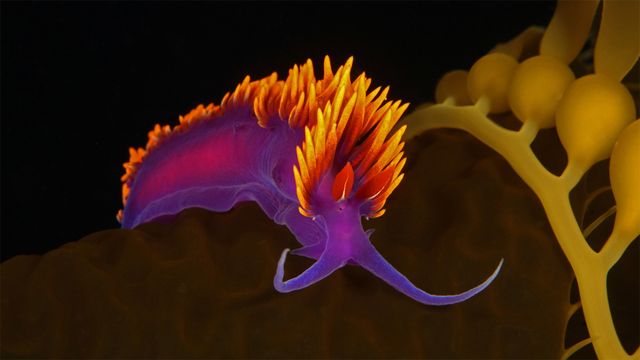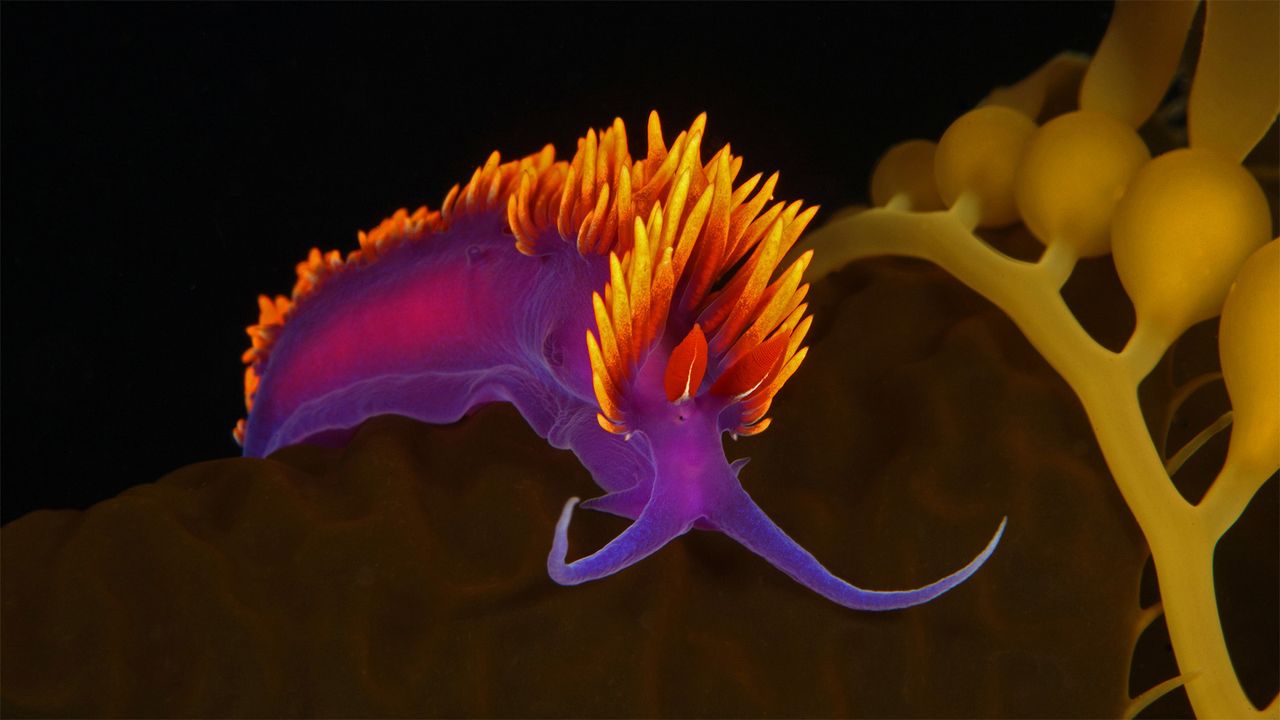
Spanish shawl nudibranch on kelp off Santa Catalina Island, Channel Islands, California
© WaterFrame/Alam
The stylish Spanish shawl
Today we're meeting one of a motley group of sea slugs called the nudibranchs (rhymes with 'thanks'), known for their unique, often complex shapes and neon-bright colors that help discourage predators. The Spanish shawl's fire-orange mane is made up of tendrils called cerata that mainly act as gills. But that mane also retains venom from the slug's prey—sea anemones—treating any would-be devourers to a painful sting. Should a ravenous sea star disregard these defenses and get too close for comfort, the Spanish shawl has a Plan B: By flapping its whole 2- to 3-inch body like a gelatinous wing, the nudibranch can flutter into open water for a quick escape.
Related Images
 At Casa Batlló for Sant Jordi’s Day in Barcelona, Spain
 'Infinite Variety: Three Centuries of Red and White Quilts' at the American Folk Art Museum in New York City in 2011, for National Quilting Day
 Lanterns at Datang Furong Garden, Tang Paradise, Xi'an, China
 Detail of a portobello mushroom
 Black-crested titmouse in Texas Hill Country
 Hardee County Fair in Wauchula, Florida
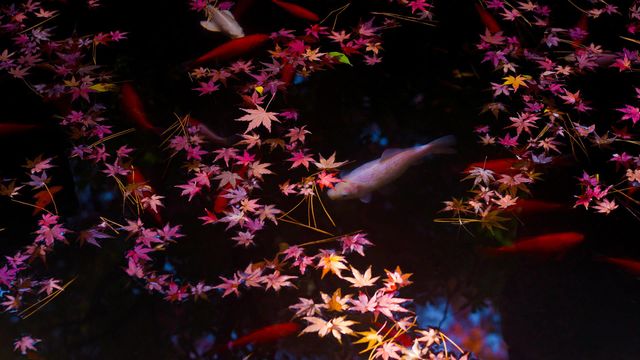 Autumn leaves and goldfish in Tokyo, Japan
 Dubai Miracle Garden, United Arab Emirates
Bing Today Images




Bison in Wind Cave National Park, South Dakota
Jan 09, 2023
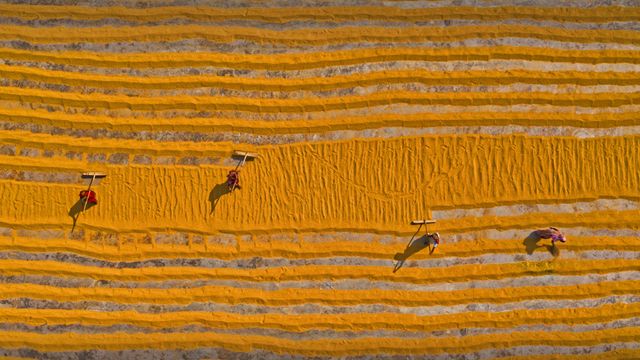
Rice laid out to dry in Dhamrai, Dhaka, Bangladesh
Jan 09, 2022


Mua Caves in the Ninh Bình province of Vietnam
Jan 09, 2019



The Alberta Rockies in Kananaskis Country, Canada
Jan 09, 2016