
Wheatear and flowering heather, Peak District National Park, England
© Ben Hall/Nature Picture Librar
Perched and poised. Wheatear, Peak District National Park, England
You don't need to be a bird expert to notice the wheatear darting across open ground. These ground-dwelling songbirds belong to the Oenanthe genus and are known for their upright posture and habit of hopping or sprinting between perches. Despite the name, wheatears have nothing to do with wheat or ears—the name is a twist on the old phrase 'white arse,' pointing to the bird's distinctive white rump found in most species. Globally, there are around 20 species of wheatears, but in North America, the northern wheatear is the one you're most likely to encounter.
It weighs less than a kilogram, but travels thousands of kilometres between its summer homes in Alaska and northern Canada to its wintering grounds in Africa. Its migration route is one of the longest for a bird its size, crossing oceans and continents. Unlike many backyard songbirds, wheatears prefer wide-open spaces with low vegetation, where they can sprint and pounce on insects. And while most North American birders might only catch them in the far north, wheatears are widespread across Europe, Asia and Africa.
Related Images
 A reddish egret hunts in Fort De Soto Park, Florida, USA
 Japanese crane in Hokkaido, Japan
 Great blue herons in the Wakodahatchee Wetlands, Delray Beach, Florida
 Blue-footed booby, Galápagos Islands, Ecuador
 Southern rockhopper penguins, Falkland Islands
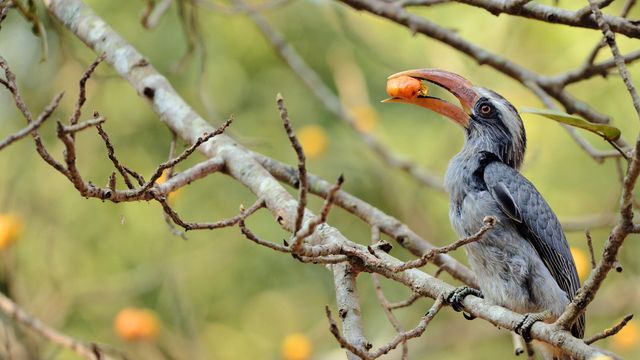 Malabar grey hornbill feeding on a fig tree at Dandeli, Karnataka
 Bald eagle pair with a chick in their nest near the Yukon River, Yukon, Canada
 Male Atlantic puffin gives his mate nesting material, Skomer Island, Wales
Bing Today Images