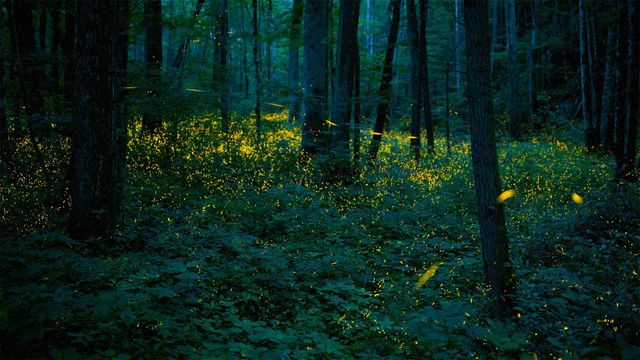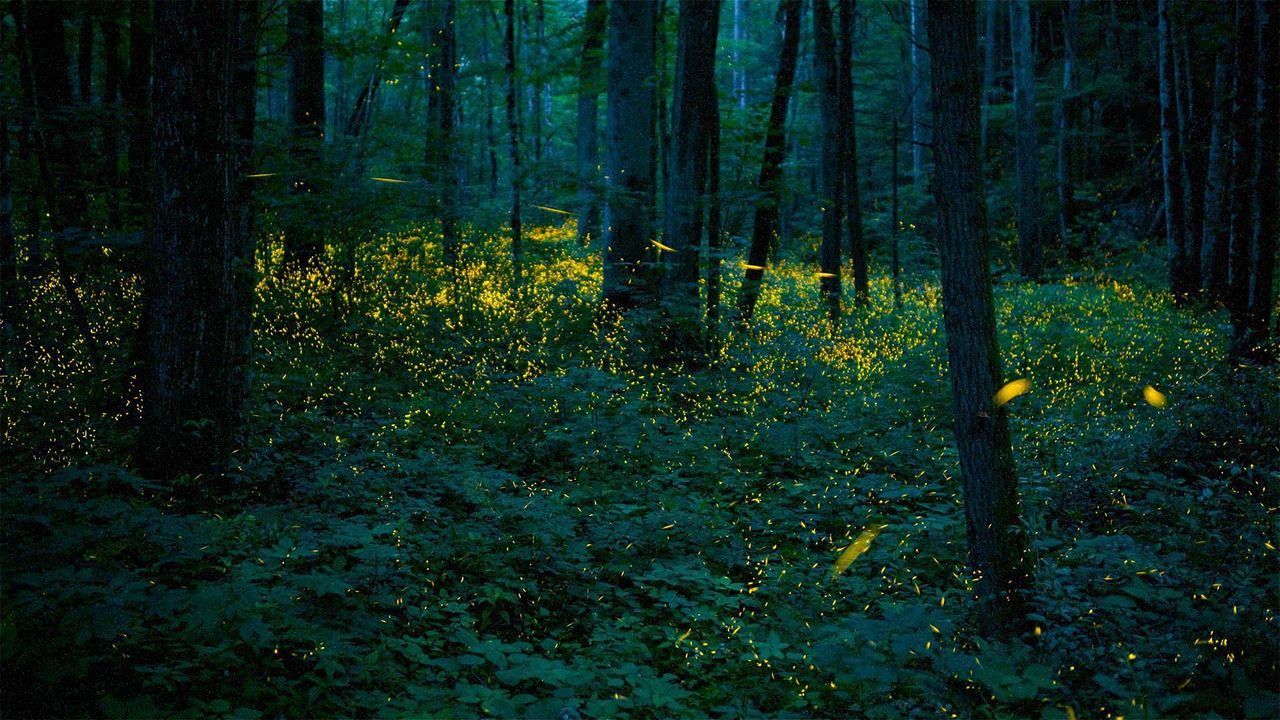
Synchronous fireflies illuminate the forests of Great Smoky Mountains National Park, Tennessee, USA
© Floris van Breugel/Minden Picture
By the light of the fireflies
Every year between late May and mid-June, synchronous fireflies gather into a sparkling, rhythmic light show in the forests of Great Smoky Mountains National Park in the southeastern US. As part of their two-week mating display, the female lighting bugs synchronise their flashes with nearby males so that every few seconds waves of light ripple through the woods. While Photinus carolinus is only one of at least 19 species of fireflies that live in Great Smoky Mountains National Park, synchronous fireflies can be found in a few other places on Earth as well, particularly in Southeast Asia.
Each species of firefly has a characteristic flash pattern that helps the males and females recognise each other. In most species, like this one, the males fly and flash, while the females generally stay still and respond with a flash of their own. It's not clear why some species of fireflies flash synchronously, although some hypotheses involve diet, social interaction, and altitude. No matter why they do it, the flashing of lightning bugs is a magical sight to see - and we can all use a little magic sometimes
Related Images
 Highbush blueberry plants in Acadia National Park, Maine
 County Bridge in New Hampshire
 Meditation domes at the Beatles Ashram in Rishikesh, India
 Ring-tailed lemurs in Madagascar for World Lemur Day
 Letchworth State Park, New York
 Lake Dobson in Mount Field National Park of Tasmania
 A mountain gorilla eating in a tree in the Bwindi Impenetrable National Park, Uganda
 Blooming jacaranda trees in New Farm Park, Brisbane, Australia
Bing Today Images