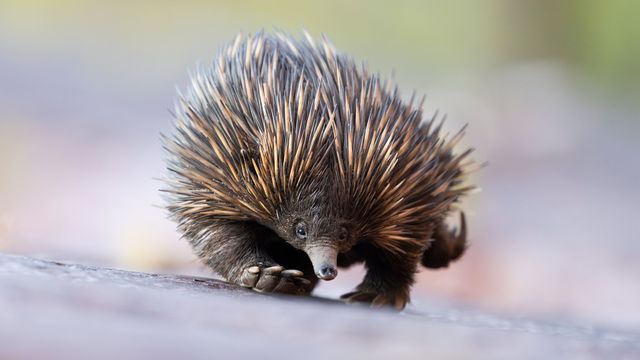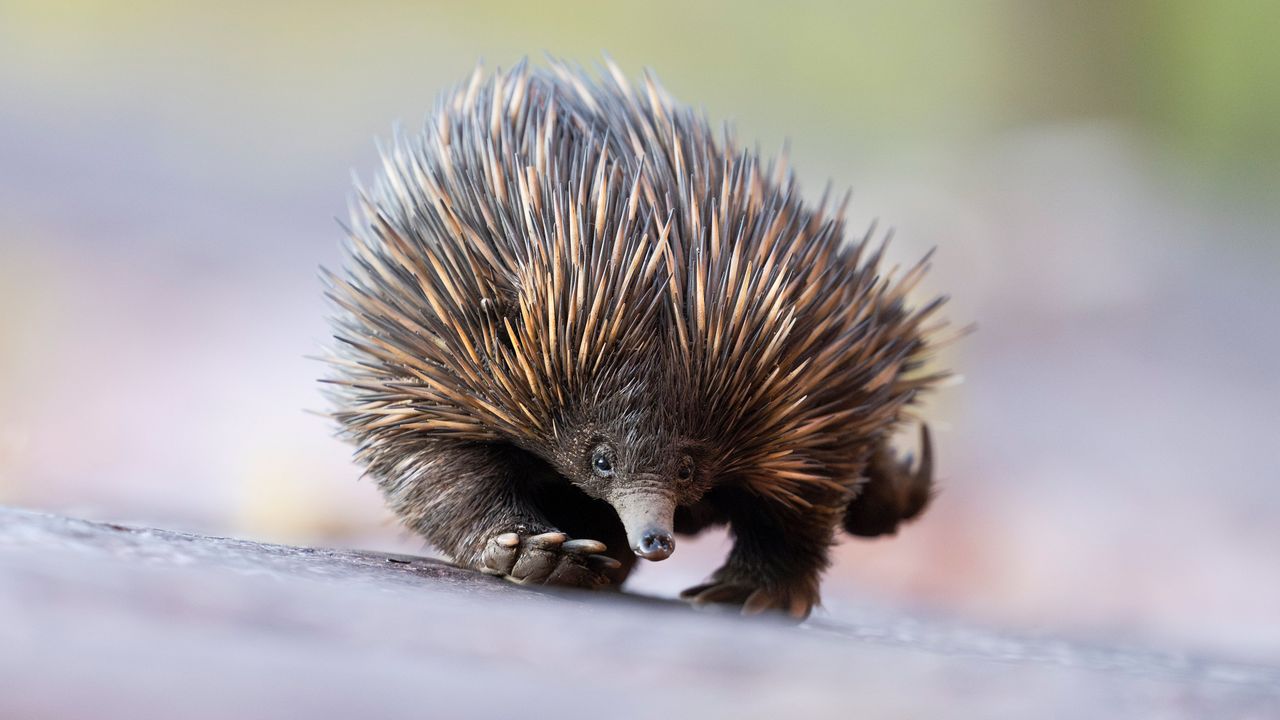
Short-beaked echidna, Adelaide Hills, Australia
© Etienne Littlefair/naturepl.co
Spike your curiosity. Short-beaked echidna, Adelaide Hills, Australia
An egg-laying mammal. No teeth. Reptilian gait. Built-in body armour. If the short-beaked echidna sounds like a checklist of contradictions, that's because it is—and it owns it. Native to Australia, Tasmania and parts of New Guinea, it's one of the few surviving monotremes, or mammals that lay eggs. Despite the headlines, it still qualifies as a mammal: it has fur, produces milk and is warm-blooded. The twist? Milk is released through specialised skin patches rather than nipples, leaving the young to lap it up.
Ants and termites make up most of its diet. A long snout with electroreceptors helps detect prey underground before strong claws break in and a sticky tongue finishes the job. Defence is equally direct. Spines—modified hairs—deter predators, while digging straight down or curling into a ball seals the deal. Echidnas are mostly solitary but briefly social during breeding season in slow-moving 'echidna trains.' Long-lived and unhurried, they prove that evolution doesn't need upgrades when the design already works.
Related Images
 Ice-fishing village near L'Anse-Saint-Jean, Quebec, Canada
 Scenic view of frozen lake, Ladakh.
 Houseboats parked on the banks of Jhelum River, Kashmir
 The village of Aguerd Oudad and the larger town of Tafraout in Morocco
 Mua Caves in the Ninh Bình province of Vietnam
 At the top of Mount Fuji in Japan. Happy New Year!
 Siberian Snowkiting Cup in Novosibirsk, Russia
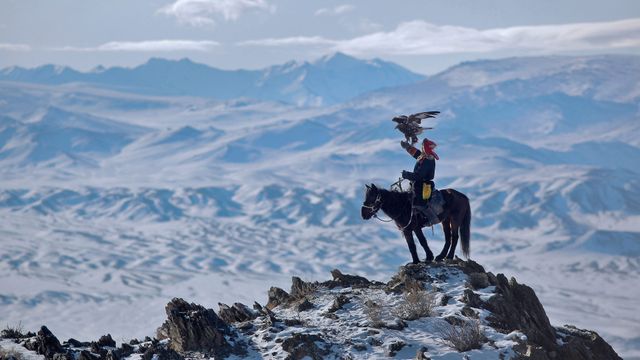 A rider hunts with an eagle in the Altai Mountains of Mongolia
Bing Today Images