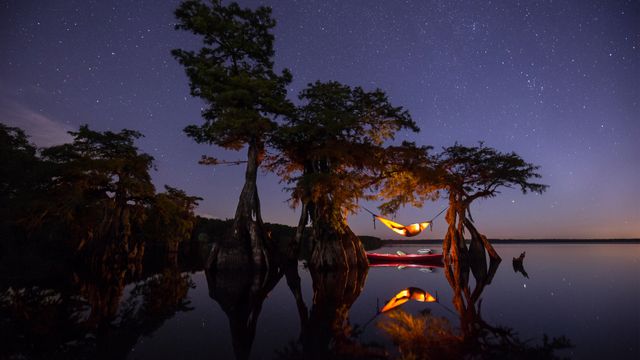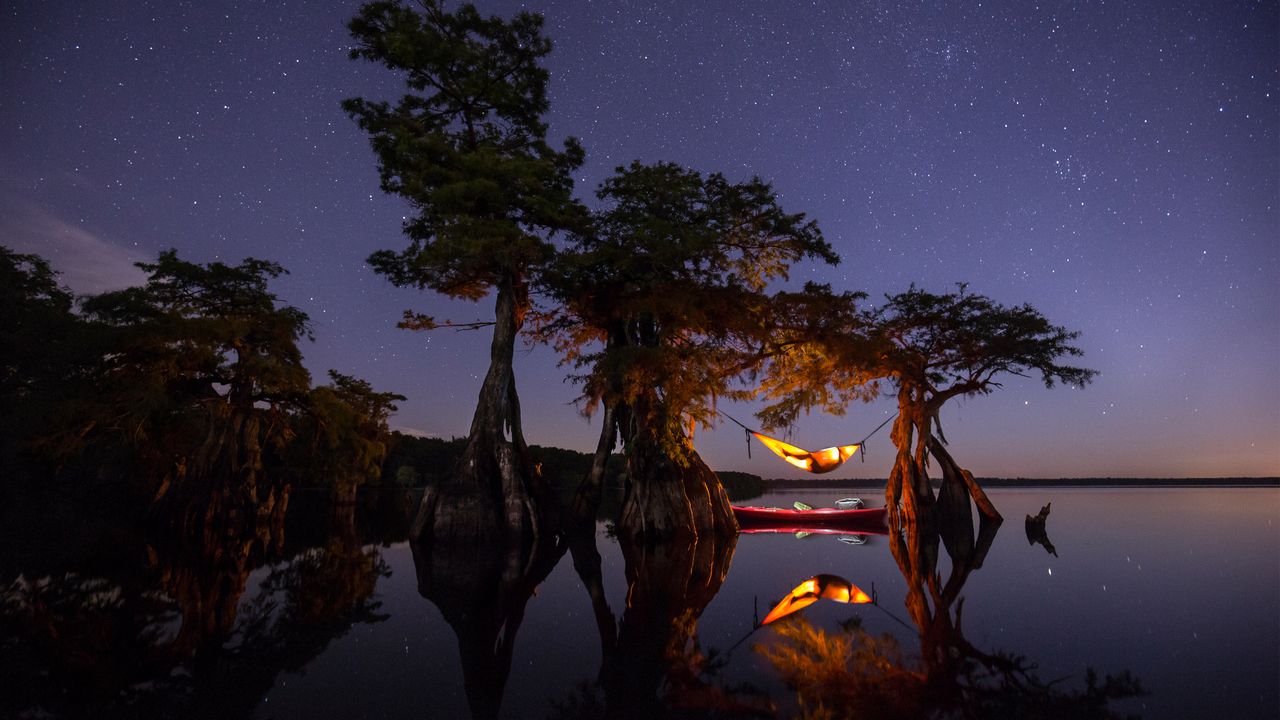
Hammock camping on a lake in Central Florida
© Mac Stone/Tandem Stills + Motio
Just 'hanging' out. Hammock Day
Imagine swaying gently under a canopy of leaves, a soft breeze coaxing you into a serene slumber while you gaze at the stars above. Observed every July 22, Hammock Day is not just a nod to the lazy lull of summer days, but an homage to an ancient tradition. Invented by the Indigenous peoples of Central and South America, hammocks were called 'Hamacas' and were originally woven for sleep and relaxation. Back then hammocks were made from the bark of trees, whereas now they can be made of various materials like cotton, nylon and canvas.
Hammocks come in different shapes and sizes, like Nicaraguan hammocks, which are usually made of woven material with a wooden spreader bar. These sleeping swings have sailed across oceans as sailor beds, swung from the trees as forest dwellers' bedrooms and nowadays, add a touch of chill to hip outdoor retreats. They have health benefits, too; gentle rocking can improve your sleep and even relieve stress. So go ahead, jump into a hammock, and let it gently sway your worries away for a while.
Related Images
 Moons of Jupiter—Io, Europa, Ganymede, and Callisto
 A view of Uranus taken from spacecraft Voyager 2 in 1986
 The Large Magellanic Cloud, photographed by the Hubble Space Telescope
 The Villarrica volcano in Chile on September 2, 2018
 Solar eclipse sequence from August 21, 2017
 Earthrise across Mare Smythii on the moon
 Bubble Nebula (NGC 7635)
 Climbing Athabasca Glacier in Jasper National Park, Alberta, Canada as the Aurora Borealis glows
Bing Today Images