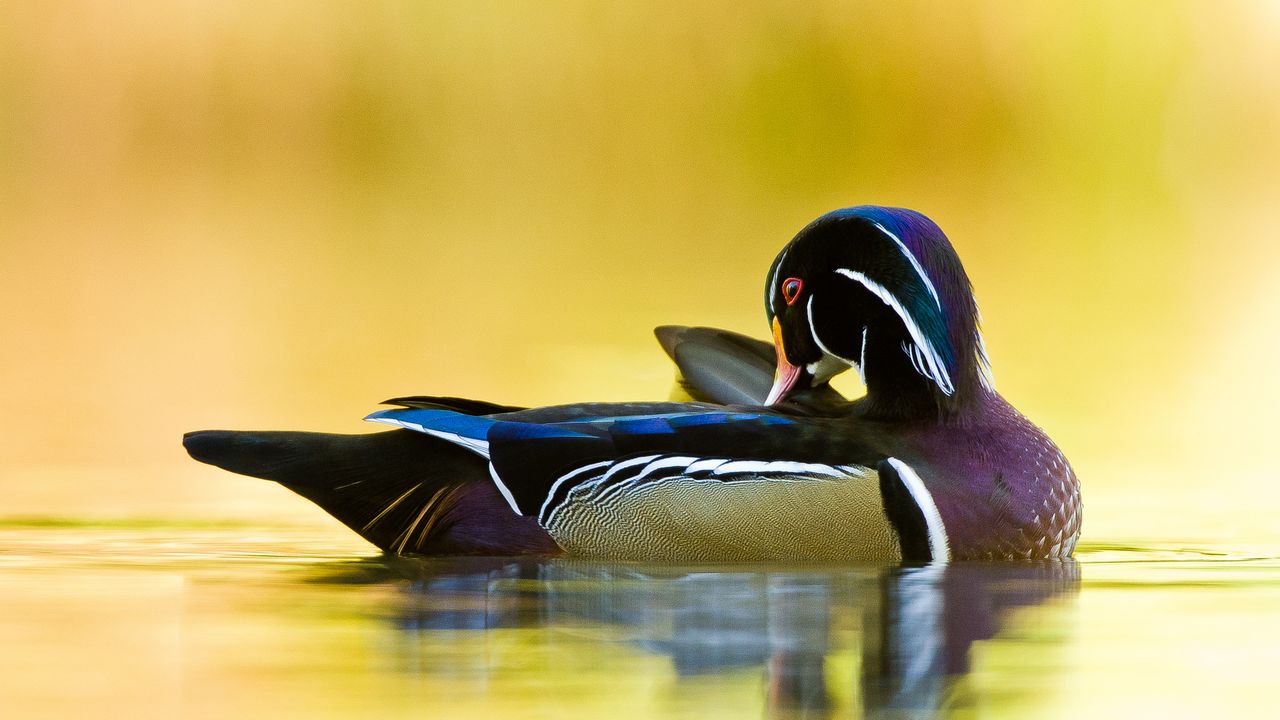
Wood duck, Quebec, Canada
© Maxime Riendeau/Getty Image
Winging it across continents. World Migratory Bird Day
Celebrate our travelling feathered friends on World Migratory Bird Day! Some migrations are truly astounding. The bar-tailed godwit embarks on an 11,000-kilometre nonstop flight across the Pacific from Alaska to New Zealand. The tiny ruby-throated hummingbird, weighing less than a nickel, makes the trip across the Gulf of Mexico—a seemingly impossible feat for its size. Migratory birds navigate the globe, instinctively knowing when and where to move to exploit seasonal abundance. The Arctic tern outshines them all with its intercontinental journey from pole to pole, covering 30,000 kilometres. Their migration routes are passages created based on environmental cues.
Let's take a moment to admire the vibrant plumage of the wood duck, photographed in Quebec, and featured here today. Wood ducks, like the one in today's image, nest in tree cavities close to water and sometimes take advantage of man-made boxes. During the breeding season, from February to April, you'll find the females laying 7–15 eggs. After breeding in the eastern and western United States and southern Canada, these ducks migrate southward in the fall to avoid harsh winter conditions. By October and November, they move towards milder climates in the southeastern United States and occasionally into Mexico.
Related Images
 Great cormorants gliding through a snowstorm in Hesse, Germany
 Hamerkop standing on a hippo, Mana Pools National Park, Zimbabwe
 Southern rockhopper penguins on the Falkland Islands
 Sea otter mother and newborn pup, Monterey Bay, California
 Mandarin duck hen with ducklings in South Korea
 Two mute swan chicks shelter under mom's tail feathers at Massapequa Preserve, Long Island, New York
 Trumpeter swans at Kelly Warm Springs, near Kelly, Wyoming
 Male king eider ducks swimming in Troms og Finnmark, Norway
Bing Today Images