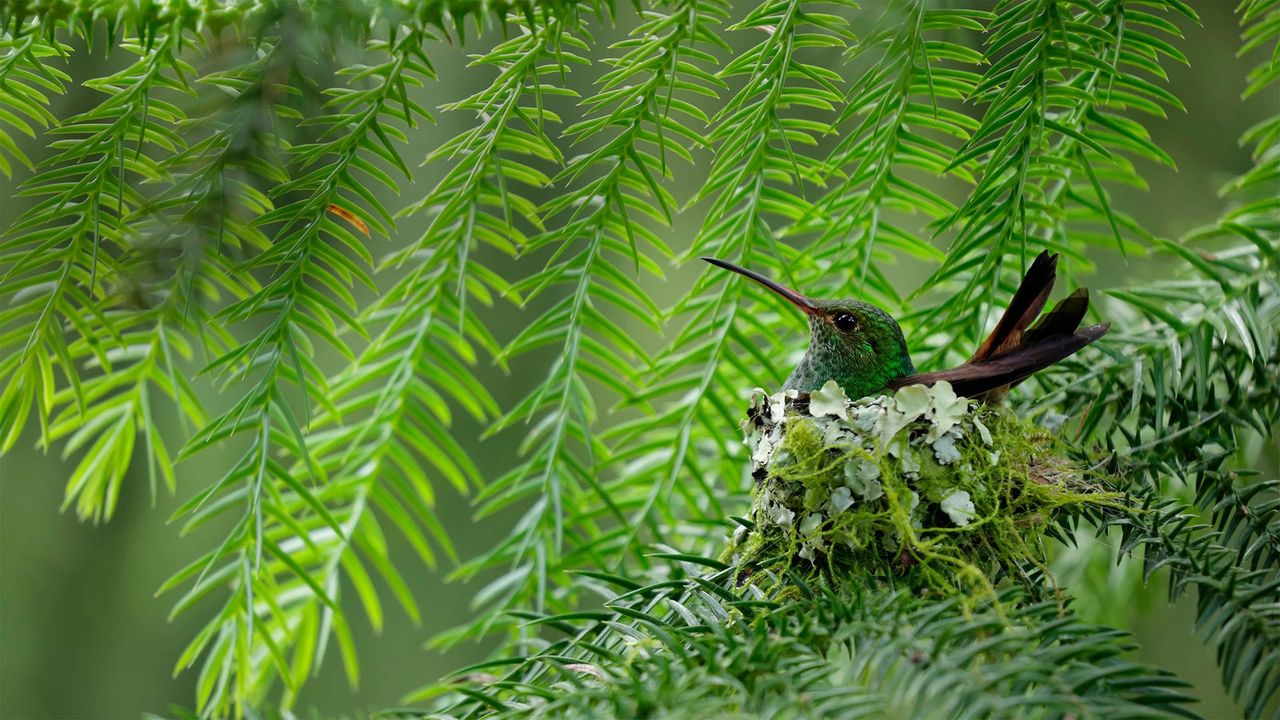
A rufous-tailed hummingbird in Costa Rica
© Juan Carlos Vindas/Getty Image
Small but mighty. Let us introduce you…
Say hello to the rufous-tailed hummingbird. This female is sitting in her tiny nest. Males look similar—lots of green, just like the females, but they have a bit more glitter on the throat and breast. Both sexes have a reddish-brown (rufous) forked tail—hence the name. Rufous-tailed hummingbirds are found in forests, gardens, and coffee plantations from southern Mexico down into South America, and they play an important role in pollination. Not to be confused with the smaller rufous hummingbird, which migrates through North America, the rufous-tailed is medium-sized and, like most hummingbirds, is very territorial when it comes to protecting its favorite feeding spots.The female is the nest-builder of the pair, creating a tiny cup out of plant fibers, cobwebs, lichen, and moss. She usually lays two eggs, which take between 15 and 19 days to hatch. The chicks will fledge, or get their flying feathers, about 20 days later. But they won't be fully independent from mom until they're around 58 days old. And dad? He doesn't participate in chick-rearing.
Related Images
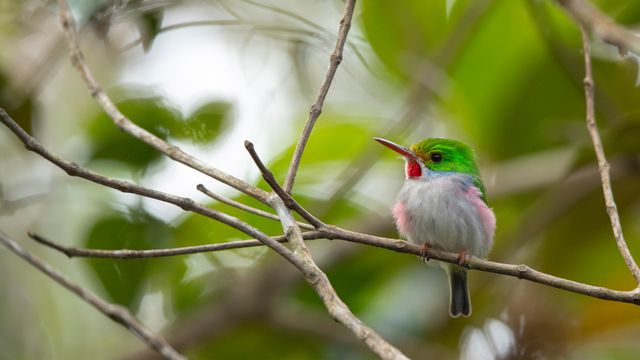 Cuban tody, Alejandro de Humboldt National Park, Cuba
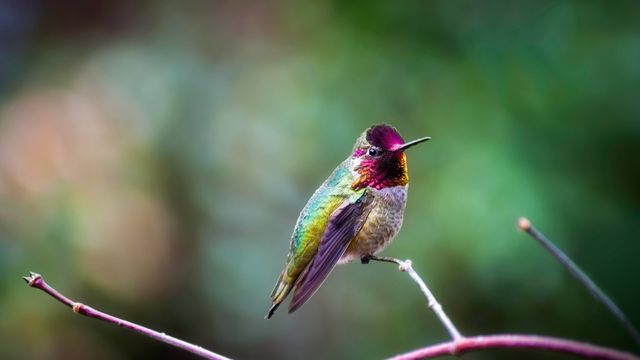 Anna's hummingbird
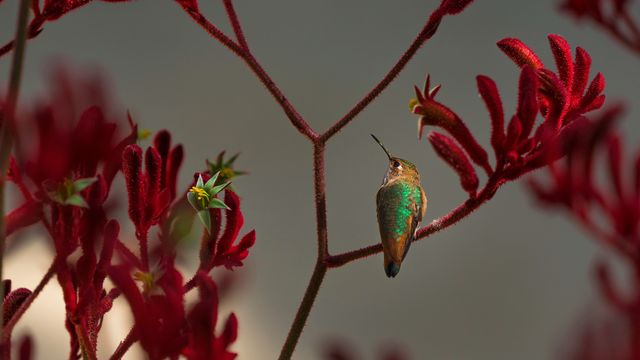 Allen's hummingbird perched on a red kangaroo paw plant
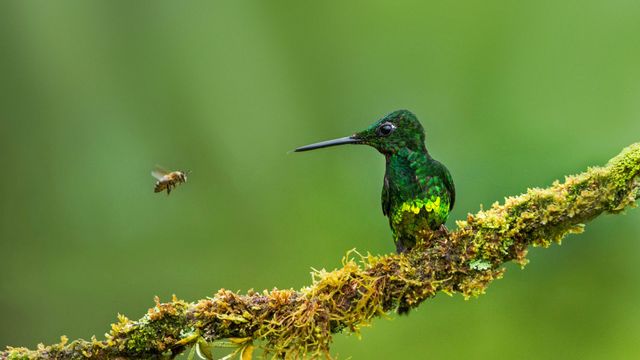 Empress brilliant hummingbird and a bee in Colombia
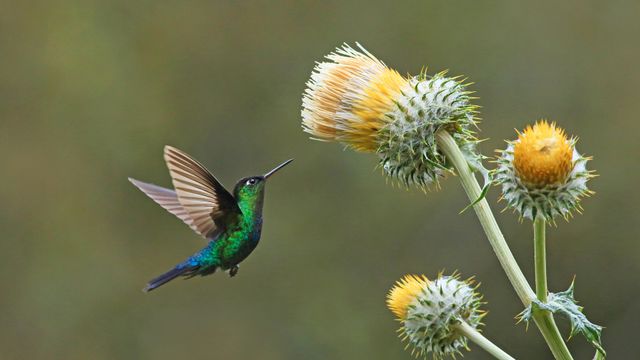 Green-crowned brilliant hummingbird with giant thistle, Cerro de la Muerte, Costa Rica
 European bee-eaters in the Extremadura region of Spain
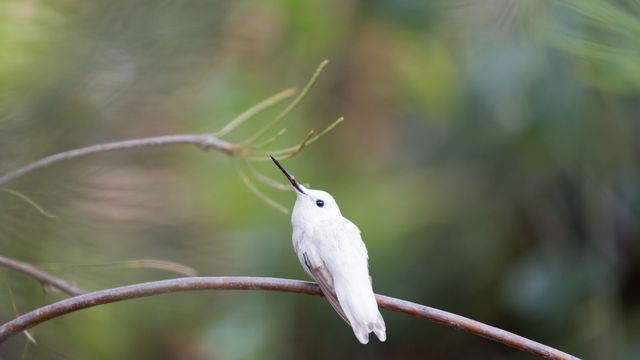 Leucistic Anna's hummingbird in the Australian Garden, UC Santa Cruz Arboretum, California
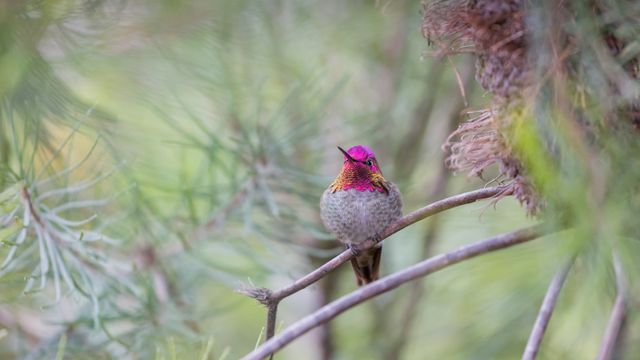 Anna's hummingbird, Santa Cruz, California
Bing Today Images